
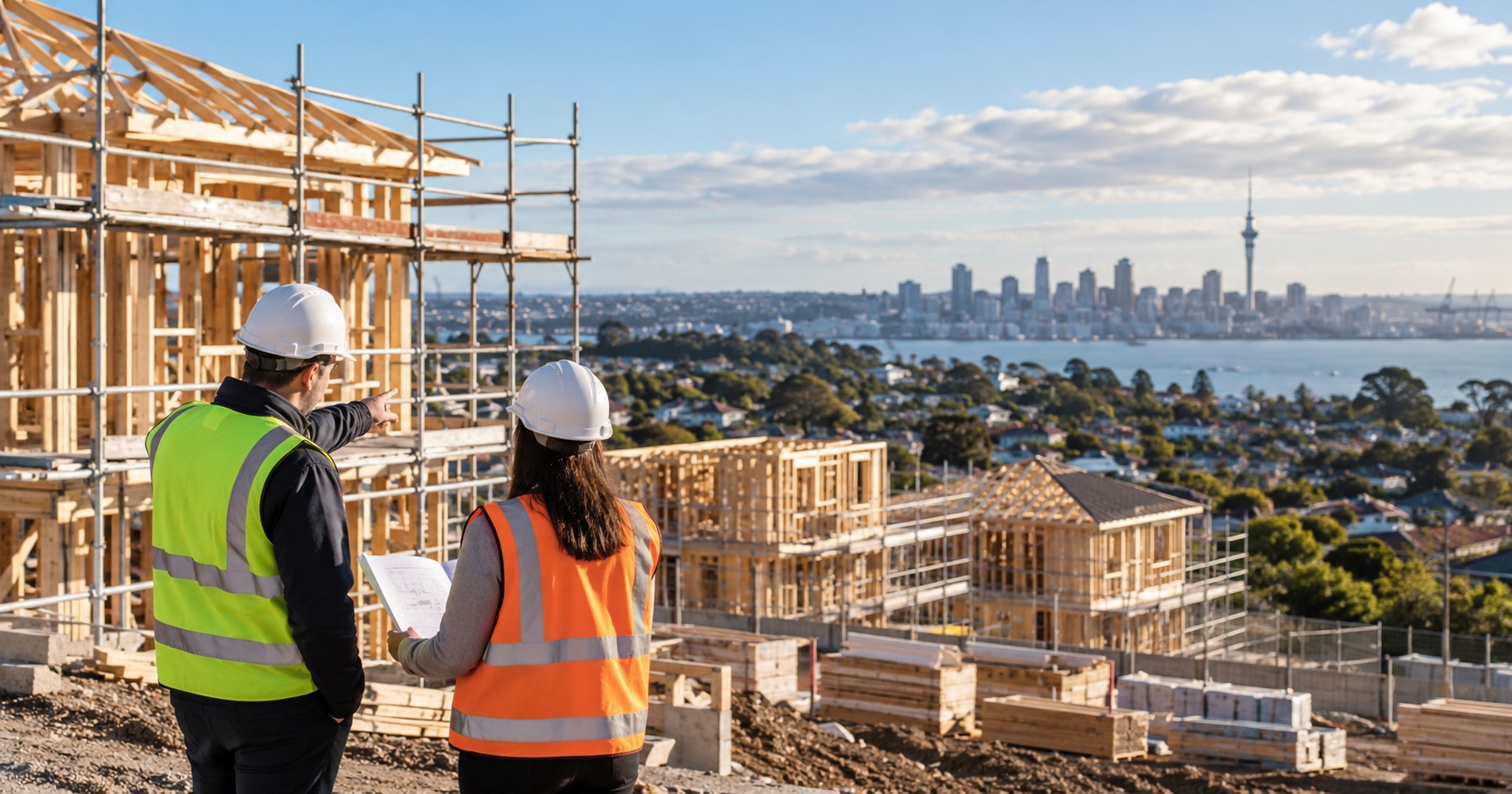
NZ home consents rise 21% as developers weigh funding risks
New Zealand consented 41,268 new homes in the year ended August 2026, up 21% on the previous year, according to Stats NZ figures released on 1 October. The seasonally adjusted monthly number rose 5.6% in August, reversing July’s 4.5% decline.
For developers and property investors, the figures suggest a larger pipeline of potential work. The financing question is whether individual projects can move from approval to completion on terms that remain workable if costs rise or sales take longer than expected.
A larger pipeline, not guaranteed construction
The annual increase was particularly strong in townhouses, flats and units, with 18,085 consented, up 25%. Apartment consents moved in the opposite direction, falling 4% to 2,381. That divergence matters: the national headline does not describe every development type equally.
Auckland recorded 17,264 new-home consents over the year, up 19%, while Canterbury recorded 8,933, up 35%. These regional differences argue against using a national growth rate as the demand forecast for a particular site.
Consents are approvals, not completed homes or committed finance. In its 1 October Construction Crossroads research, BNZ noted reports from industry participants that projects were being paused or scaled back and that consents were not translating into activity as reliably as previously.
Buyer demand still shapes the repayment plan
The wider sales market provides another reason for caution. REINZ’s August report recorded 5,430 residential sales, down 13% year-on-year. Properties took a median of 51 days to sell, three days longer than a year earlier, while available inventory rose 9.7%.
These are whole-market measures, not a timetable for selling a particular new development. Nevertheless, they support a practical financing question: how long can a project carry completed stock before sale proceeds are needed to repay its construction loan?
Developers assessing housing-market conditions should distinguish an attractive proposed selling price from evidence that buyers will transact at that price. A finance model also needs to recognise the difference between completing construction, signing a sale and receiving settlement funds.
Interest-rate risk has not disappeared
BNZ expects modest residential construction growth over the next nine to 12 months, but identifies rising costs, a flat property market and higher interest rates as constraints. That is the bank’s forecast, not a guaranteed outcome for activity or borrowing costs.
The Treasury’s Pre-election Economic and Fiscal Update, released on 29 September, also warns that persistently elevated energy prices could prolong inflation and require higher interest rates for longer. This is a downside risk scenario, rather than a prediction of the rate any developer will be offered.
The implication for feasibility assessments is to test more than one financing scenario. A project should not depend solely on an assumed rate cut or a quick improvement in sale prices to make its repayment plan work.
Commercial projects need a separate assessment
The residential headline should not be read as evidence of an equivalent commercial building boom. Stats NZ recorded NZ$8.9 billion of non-residential building work consented in the year to August, up 2.2%. This is a measure of consented value, not completed construction volume.
Commercial and mixed-use developers therefore need to examine their own tenant demand, leasing assumptions and repayment options, rather than carry the housing consent growth rate into an unrelated business case.
What this means for construction finance
The practical response is a project-level funding review, not an automatic decision to increase borrowing.
Start with the remaining cost to complete. Reconcile the construction budget, contingency, professional fees and financing costs with the funds actually available. A facility that covers the building contract but leaves insufficient room for delays can still create a cash shortfall.
Then test the timing. Map when equity must be contributed, when progress payments fall due, and when loan drawdowns can occur. Prudential’s development-finance information describes staged funding against quantity-surveyor progress reports and the use of capitalised interest during construction. Adding interest to the loan changes when it is paid; it does not remove the cost.
Finally, examine the repayment route. For a build-to-sell project, test slower sales and lower net proceeds. For a retained asset, test whether rental income and a realistic valuation support refinancing. Treat a hoped-for refinance as an assumption to verify, not as money already secured.
Where private capital fits
Prudential Finance describes a lender-and-broker model spanning private property loans, construction funding and debt-and-equity structures. Its property development finance services are relevant to the task of matching a project’s funding structure with its construction and repayment timetable.
That relevance does not establish that private capital is cheaper, that higher leverage is appropriate, or that every consented project can obtain funding. Comparisons should consider total costs, conditions, security requirements and repayment obligations, alongside the headline interest rate.
The opportunity in the latest figures is a wider pool of potential projects. Turning that opportunity into completed property depends on a narrower test: whether the specific development can fund its full journey from construction through to repayment.
Source attribution:
Stats NZ’s August 2026 building-consent release; BNZ’s Construction Crossroads research; REINZ’s August 2026 market report; and the Treasury’s September 2026 pre-election update. Prudential’s service descriptions are company-provided information.
General information only. This article is not personalised financial advice.